
Why Dolvero Restricts News Trading
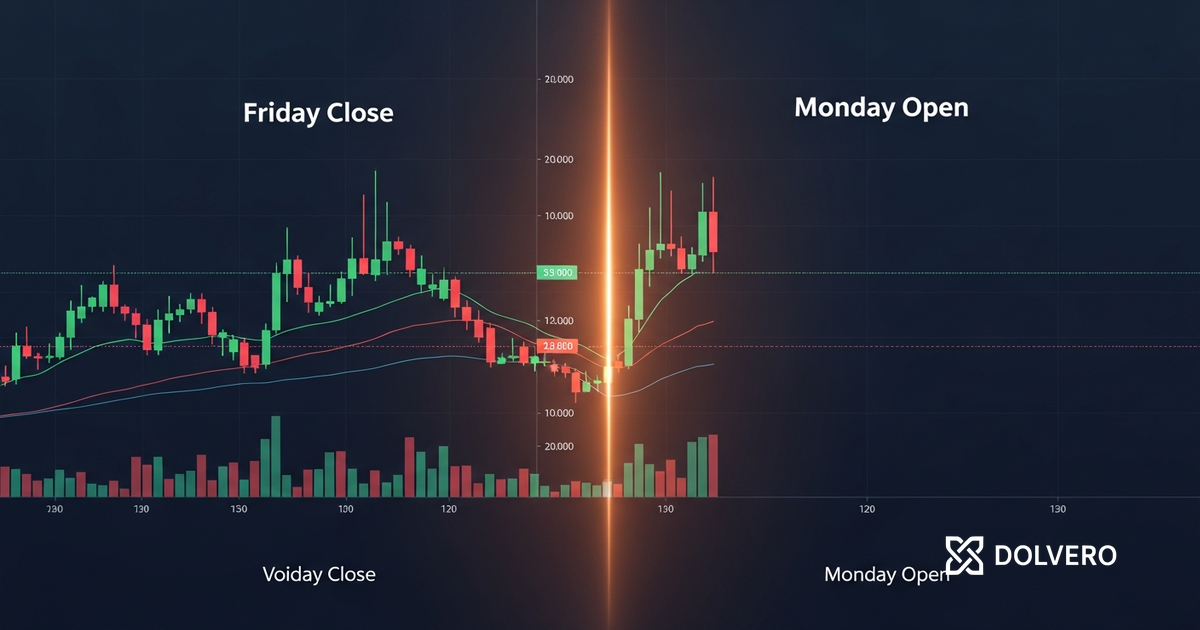
High-impact macroeconomic events create extreme volatility windows where price action becomes unpredictable, spreads widen dramatically, and slippage can turn a carefully planned trade into a catastrophic loss. For a proprietary trading firm managing real capital across thousands of funded accounts, uncontrolled exposure during these events represents systemic risk that no responsible firm can ignore.
At Dolvero, we have implemented a +/- 30 minute news trading restriction around specific high-impact economic events. This rule exists not to limit your profitability, but to ensure that your funded account performance reflects genuine trading skill rather than binary event gambling. Understanding exactly how this rule works, which events trigger it, and how to plan your trading day around it will help you stay compliant and focused on sustainable edge extraction.
How the +/- 30 Minute Rule Works
The restriction is straightforward: you may not open new positions or close existing positions within 30 minutes before or 30 minutes after a designated high-impact news event. This creates a 60-minute total window around each event during which your trading activity is restricted.
What Counts as a Violation
- Opening a new position within the 30-minute window before or after the event
- Closing an existing position within the window (including manual closes, stop-losses that trigger within the window are evaluated on a case-by-case basis)
- Modifying stop-loss or take-profit levels on open positions during the restricted window
- Hedging or adding to positions in correlated instruments during the window
What Is Permitted
- Holding an existing position through the news event, provided it was opened before the restricted window began
- Having a stop-loss or take-profit that was set before the window — if your pre-set SL/TP triggers during the event, this is generally acceptable as it reflects pre-planned risk management
- Trading instruments unrelated to the news event — if NFP is releasing, you can still trade instruments with no USD correlation, though caution is advised as major events can create cross-market volatility
For the complete and most up-to-date version of all trading rules, always refer to our official rules page.
Which Events Trigger the Restriction
Not every economic data release triggers the news trading restriction. Only events classified as high-impact that historically produce significant price dislocations are covered. Here is the definitive list of restricted events:
Non-Farm Payrolls (NFP) — First Friday of Each Month
The US Non-Farm Payrolls report is arguably the single most market-moving scheduled event in global financial markets. Released at 8:30 AM Eastern Time on the first Friday of each month by the Bureau of Labor Statistics, NFP measures the change in the number of employed people in the US economy, excluding farm workers, government employees, private household employees, and employees of nonprofit organizations.
NFP regularly produces 50-100+ pip moves in major USD pairs within seconds of release. The February 2026 NFP is scheduled for February 7th. For this event, the restricted window runs from 8:00 AM to 9:00 AM Eastern Time. No new positions should be opened in any USD-correlated pair during this window.
Key pairs affected: EUR/USD, GBP/USD, USD/JPY, USD/CHF, USD/CAD, AUD/USD, NZD/USD, XAU/USD (Gold), and all USD crosses.
Consumer Price Index (CPI) — Monthly
CPI data measures inflation at the consumer level and is the primary input the Federal Reserve uses when making interest rate decisions. Both the headline CPI (including food and energy) and core CPI (excluding food and energy) can trigger massive market reactions, particularly when the actual reading deviates from consensus expectations.
CPI is typically released at 8:30 AM Eastern Time, usually around the 12th-14th of each month. The restricted window applies identically to NFP: 30 minutes before and 30 minutes after the release timestamp.
Central Bank Interest Rate Decisions
Interest rate decisions from major central banks represent the most impactful category of news events. The following central bank announcements are covered by the restriction:
- Federal Reserve (FOMC) — Rate decisions, FOMC statements, and press conferences. Typically released at 2:00 PM Eastern Time, with press conferences at 2:30 PM. The full restricted window covers 1:30 PM to 3:00 PM ET.
- European Central Bank (ECB) — Rate decisions and press conferences. Main announcement at 2:15 PM CET, press conference at 2:45 PM CET.
- Bank of England (BoE) — Monetary Policy Summary and rate decision, typically at 12:00 PM GMT.
- Bank of Japan (BoJ) — Rate decisions, timing varies but typically early morning Tokyo time.
- Reserve Bank of Australia (RBA) — Rate decisions at 2:30 PM AEST.
- Bank of Canada (BoC) — Rate decisions at 10:00 AM Eastern Time.
- Swiss National Bank (SNB) — Quarterly rate decisions at 9:30 AM CET.
- Reserve Bank of New Zealand (RBNZ) — Rate decisions at 2:00 PM NZST.
Other High-Impact Events
- GDP releases (advance, preliminary, and final readings for major economies)
- PMI data (ISM Manufacturing and Services PMI for the US)
- Employment data beyond NFP (ADP Employment Change, Jobless Claims when preceded by unusual expectations)
- Retail Sales (US, UK, Eurozone)
We recommend using a professional economic calendar and filtering for high-impact events. If an event is flagged as high-impact on major calendar providers (Forex Factory, Investing.com, TradingView), assume the restriction applies when trading the affected currency.
How to Structure Your Trading Day Around News Events
The news restriction should not feel like a limitation — it should feel like a structural advantage. Here is how professional traders at funded firms handle news windows:
Pre-Session Planning
Before each trading day, check the economic calendar for the session you plan to trade. Identify all high-impact events, note their exact release times, and calculate your restricted windows. Mark these windows on your chart or trading journal so you have a visual reminder.
Position Management Before the Window
If you have an open position that will be running into a news window, you have two options: close it before the restriction begins (at least 31 minutes before the event), or let it run through the event with your pre-set stop-loss and take-profit in place. The decision depends on your trade thesis and risk tolerance. If your trade is already in significant profit, taking profits before the window is often the prudent choice.
Post-Event Re-Entry
After the 30-minute post-event window expires, markets typically settle into a new range or trend. This post-news period can offer excellent trading opportunities as the market digests the data and institutional flow establishes the new direction. Many funded traders find their best setups in the 30-90 minute window after the restriction lifts.
Using the London-New York Overlap
Most high-impact US data releases occur at 8:30 AM Eastern Time (1:30 PM GMT), which falls during the London-New York session overlap. This means the restricted window typically runs from 1:00 PM to 2:00 PM GMT. Plan to focus your morning London session trading before this window, and your New York session trading after it.
Common Mistakes to Avoid
Mistake 1: Ignoring Cross-Currency Correlation
If US CPI is releasing, the restriction applies to all USD pairs. Some traders make the mistake of thinking they can trade EUR/GBP during a USD event. While EUR/GBP has no direct USD component, major USD events can still create volatility across all major pairs. Trade with caution.
Mistake 2: Setting Tight Stops Before News
If you are holding a position through a news event (which is permitted if opened before the window), setting an extremely tight stop-loss invites being stopped out by the spike. Either widen your stop to account for event volatility or close the position before the window.
Mistake 3: Immediately Trading After the Window
The restriction lifts exactly 30 minutes after the event, but this does not mean you should immediately enter a trade. Wait for the dust to settle, let the initial volatility subside, and look for a clear setup. The best post-news trades typically form 30-60 minutes after the event, not immediately when the window reopens.
Mistake 4: Not Checking the Calendar Daily
Unscheduled speeches by central bank governors, emergency rate decisions, or geopolitical events can also trigger restrictions. Make it a habit to check the economic calendar every morning before your first trade.
Mistake 5: Confusing the Restriction Window Across Time Zones
If you are trading from a different time zone than where the event is released, double-check that you have converted the event time correctly. A common error is confusing Eastern Time, Central European Time, and GMT. Many calendar tools allow you to set your local time zone — use this feature and verify the conversion before every session. A miscalculation of even one hour can lead to a violation.
How Violations Are Handled
Dolvero's compliance system monitors all trading activity against the economic calendar in real time. If a trade is flagged as potentially violating the news trading restriction, the following process applies:
- First violation: A warning is issued with an explanation of the specific event and time window that was violated. The trade profit or loss may be removed from your account balance.
- Repeated violations: May result in account termination, as consistent news trading suggests a strategy built around the very risk the rule is designed to prevent.
We believe in transparency. All our rules, including the news trading policy, are published in full detail on our rules page. If you are ever unsure whether a specific event triggers the restriction, contact our support team before placing the trade.
The Bigger Picture: Risk Management as an Edge
The +/- 30 minute news rule is one component of Dolvero's comprehensive risk management framework. Alongside our 2% maximum risk per trade rule, daily drawdown limits (5% for 2-Step, 3% for 1-Step Accelerated), and static/trailing drawdown mechanisms, the news restriction ensures that funded traders are building sustainable, repeatable edge rather than relying on high-variance event outcomes.
This approach is what separates Dolvero from firms that allow unrestricted news trading and then wonder why their risk books blow up every NFP Friday. We are building a firm where traders can build long-term careers, and that requires rules that protect both the trader and the firm's capital.
Staying Informed: Tools and Resources
Dolvero provides several resources to help you navigate news events and stay compliant with the trading rules:
- Public changelog: Every update to our rules, including any modifications to the news trading policy, is documented in our changelog. Subscribe to stay informed about rule changes before they take effect.
- Live ledger: Our public live ledger provides full transparency into how funded traders are performing across all account types. You can see real payout data and verify that the firm operates as promised.
- Economic calendar integration: We recommend bookmarking a professional economic calendar (Forex Factory, Investing.com, or TradingView) and checking it daily before your first trade.
The news trading restriction is reviewed periodically, and any changes are announced with advance notice via our changelog. We believe that clear, consistently enforced rules create a fair playing field for all funded traders.
Ready to start trading with a firm that takes risk management seriously? Explore our challenge pricing, understand how the evaluation process works, and begin your challenge today. For a complete overview of all trading rules, visit our rules page.