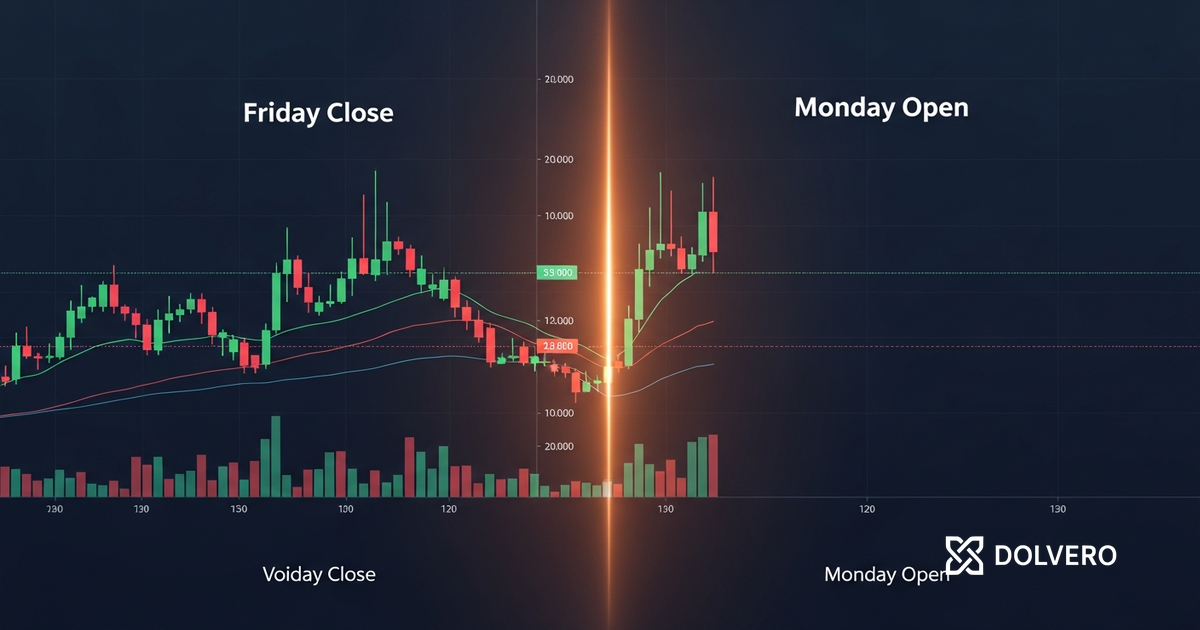



The Dolvero rules prohibit opening or closing positions within 30 minutes before or after major scheduled economic events — what we call the ±30-minute news trading rule. This is not a suggestion or a best-practice recommendation. It is a firm rule, applied uniformly, with account consequences for violations.
This article explains exactly what qualifies as a restricted event, what "±30 minutes" means in operational terms, and the risk management reasoning that makes this rule necessary for a funded trading program.
Which Events Are Restricted
Not every economic data release triggers the restriction. The ±30-minute rule applies to a specific set of high-impact scheduled events. As a general principle, these are events that:
- Are released on a predictable schedule (announced in advance on the economic calendar)
- Historically produce immediate, large, and often directionally uncertain price moves across multiple instruments
- Regularly create conditions where spreads widen significantly and liquidity temporarily deteriorates
The primary restricted events include:
United States
- Non-Farm Payrolls (NFP) — first Friday of each month, 08:30 ET / 13:30 UTC
- Consumer Price Index (CPI) — monthly release, 08:30 ET / 13:30 UTC
- Federal Open Market Committee (FOMC) rate decisions — approximately every 6-7 weeks, 14:00 ET / 19:00 UTC, plus press conference beginning 14:30 ET
- GDP advance and revision releases
- Producer Price Index (PPI)
- Retail Sales
- ISM Manufacturing and Services PMI
- Initial Jobless Claims — weekly, Thursday 08:30 ET
- Federal Reserve Chair speeches (scheduled)
European Union / Euro Area
- European Central Bank (ECB) rate decisions
- ECB press conferences
- Eurozone CPI flash estimates and final releases
- Eurozone GDP
United Kingdom
- Bank of England (BoE) rate decisions and Monetary Policy Reports
- UK CPI
- UK GDP
Other major economies
- Bank of Japan (BoJ) rate decisions
- Reserve Bank of Australia (RBA) rate decisions
- Swiss National Bank (SNB) rate decisions
- Canadian CPI and Bank of Canada rate decisions
- Chinese CPI, PMI, and trade balance data
This list is representative, not exhaustive. The authoritative source is the economic calendar maintained at /rules, which is updated when scheduled event classifications change. When in doubt, treat any event marked "high impact" on a major economic calendar service (Forex Factory, Investing.com, Bloomberg) as restricted.
What "±30 Minutes" Means in Practice
The restriction has two components:
30 minutes before the event
No new positions may be opened from 30 minutes before the scheduled release time. Positions that are already open before the 30-minute window begins may remain open — you are not required to close them before the event. However, you may not open additional positions.
Example: NFP releases at 13:30 UTC. From 13:00 UTC, you cannot open new positions on any instrument that is meaningfully affected by the NFP data. If you have an existing EUR/USD long open at 12:45 UTC, it may remain open. You cannot add to it after 13:00 UTC.
30 minutes after the event
No new positions may be opened until 30 minutes after the scheduled release time. The 30-minute restriction begins at the scheduled release time, regardless of whether the data was released slightly early or late.
Example: NFP at 13:30 UTC. You may not open new positions until 14:00 UTC. If NFP is released at 13:29 (slightly early, as occasionally happens), the restriction window still ends at 14:00 UTC — the scheduled time plus 30 minutes.
The "close" restriction
The rule also restricts closing positions during the window for positions opened specifically to exploit the event. If you opened a position within the hour before the event window began — a pattern suggesting pre-positioning for the event — closing that position during the event window is also restricted.
Positions opened long before the event (same day or earlier, as part of ongoing setups unrelated to the event) may be closed during the window if needed for normal stop-loss or take-profit management. The restriction targets event-exploitation behavior, not all position management.
Which Instruments Are Affected
The restriction is not instrument-specific in the way that, say, a single-stock news rule would be. Major economic events affect correlating instruments across markets.
For US events like NFP and FOMC:
- All USD currency pairs (EUR/USD, GBP/USD, USD/JPY, USD/CHF, AUD/USD, USD/CAD, NZD/USD)
- All major US equity indices (S&P 500, Nasdaq, Dow Jones)
- Gold (XAUUSD) — heavily correlated with USD and rate expectations
- US Treasury yields and related instruments
- Oil — USD-denominated commodity, significantly correlated
For ECB events:
- EUR pairs (EUR/USD, EUR/GBP, EUR/JPY, EUR/CHF)
- European equity indices (DAX, CAC 40, Euro Stoxx 50)
In practice, the guidance is straightforward: during a major economic event window, step away from trading entirely on all liquid instruments. The correlation effects of major data releases span asset classes in ways that are impossible to fully enumerate. A safe approach is to treat the ±30 minute window as a complete trading pause.
The Risk Logic Behind the Rule
Understanding why this rule exists helps traders internalize it rather than simply comply with it mechanically.
Spread widening
In the minutes immediately surrounding major economic releases, spreads on affected instruments widen dramatically. EUR/USD, which might trade with a 0.1-0.3 pip spread during normal market conditions, can exhibit spreads of 5-20 pips during NFP impact. This spread widening means that a position opened just before or during the release can be immediately in substantial loss purely from the bid-ask spread, before price even moves against the trader.
For a funded account where drawdown limits apply, large spread-induced losses at the worst possible moment represent an extreme risk concentration. The ±30-minute rule prevents traders from voluntarily entering this risk environment.
Slippage
Major economic events produce order flow that exhausts available liquidity at quoted prices, causing market orders and stop-losses to execute at significantly worse prices than expected. A stop-loss at a specific level may execute several pips beyond that level during a high-impact event — a phenomenon called slippage.
For a trader operating near their daily loss limit or total drawdown limit, slippage during a major event can cause an account breach that would not have occurred under normal execution conditions. This is a risk that cannot be hedged with position sizing alone.
Bidirectional uncertainty
Many major economic data points can produce price moves in either direction, depending on the deviation from consensus expectations, market positioning, and interpretation of the data in context. A better-than-expected NFP number can cause USD strength or, counterintuitively, USD weakness if traders interpret it as increasing the likelihood of Fed rate cuts being delayed.
This bidirectional uncertainty means that news event trading is not risk-adjusted speculation — it is often closer to a coin flip with extreme position size. It does not reflect the kind of genuine market edge that prop firm funded accounts are designed to support.
Infrastructure stress
Order volume during major economic releases can stress trading platform infrastructure. Execution delays, quote freezes, and order rejection events are more common during high-volatility periods. A trader caught in a position during platform stress has reduced ability to manage their exposure, which multiplies the effective risk.
Common Misconceptions
"The rule prevents me from trading the news move after it happens"
The 30-minute post-event restriction means you cannot enter at the exact moment of release or immediately after. It does not mean you cannot trade the subsequent trend. If NFP is released at 13:30 UTC and produces a strong directional move, you can trade that move — beginning at 14:00 UTC when the restriction ends. The initial spike and its immediate aftermath are restricted, not the entire trading session that follows.
"I trade non-affected instruments, so the rule doesn't apply"
The correlation effects of major economic events are widespread. Gold, oil, equities, and nearly all currency pairs exhibit some reaction to US data releases. If you are trading an instrument that you believe is genuinely uncorrelated with the event in question, contact support to confirm before relying on this assumption. Incorrect assumptions about instrument correlation have caused rule violations.
"The rule only applies to entries, not exits"
This is partially true. Stop-losses and take-profits that execute automatically during the window are not violations — you cannot control when automated orders fill. Manually opening a new position or deliberately timing a close to exploit the event-driven move within the window is a violation.
Practical Workflow for Managing the Rule
Here is a simple workflow for staying compliant:
- At the start of each trading day, check your economic calendar for high-impact events. Identify their scheduled times in UTC.
- Mark the ±30-minute restriction windows on your session plan.
- Before the 30-minute pre-event window begins, decide whether you want any existing positions to remain open through the event (permitted, with the risks described above) or whether you want to close them before the window begins.
- During the restriction window, do not open new positions. You may monitor the market, analyze the release data, and prepare your post-window trading plan.
- After the 30-minute post-event window ends, resume normal trading with your updated market analysis.
If you use MT5 pending orders, ensure that pending orders are cancelled before the pre-event window if you do not want them to trigger during the restriction period. Pending orders that fill during the restriction window count as violations if the intent was to enter during the event.
Resources for Event Tracking
We recommend maintaining an economic calendar from at least two sources to guard against scheduling errors or updates:
- Forex Factory (forexfactory.com) — filter for "High" impact events
- Investing.com economic calendar — comprehensive coverage with time zones
- Bloomberg Economic Calendar — for traders with Bloomberg access
- The Federal Reserve website (federalreserve.gov) for exact FOMC scheduling
Full rules at /rules, including the authoritative event classification list. Changelog of any event classification changes at /changelog. Start an evaluation at app.dolvero.com/start. Code 2026 for 26% off.