

Every prop trading firm faces the same problem: how do you distinguish a trader with a genuine, repeatable edge from a trader who got lucky once? Win rate alone does not answer that question. Neither does total profit. A trader could generate a 10% return by placing a single oversized position on a single day, catching one move correctly, and then sitting idle for weeks. The return is real, but the process behind it tells the firm nothing useful about future performance. Consistency rules exist to solve exactly this problem.
Dolvero's Instant Funding accounts include a 15% consistency rule, and it is the single rule that generates the most questions from traders considering this account type. This article explains precisely what the rule measures, how the calculation works, why the threshold is set where it is, and — most importantly — what practical adjustments you can make to trade profitably within it.
What the 15% Consistency Rule Actually Measures
The rule states that no single trading day's profit may exceed 15% of the total accumulated profit on the account. Put differently, your best day cannot represent more than 15% of your overall track record. The calculation is performed on realised closed-trade profit — it does not factor in floating positions, only the P&L of trades that have been completed.
Here is the practical mathematics. Suppose you have been trading an Instant Funding account for three weeks and your total realised profit is $4,000. The consistency threshold is 15% of $4,000 = $600. If any single calendar day in your trading history shows a profit exceeding $600, you are currently non-compliant. As your total profit grows, the absolute dollar threshold rises with it — meaning that historically large days can "grow into" compliance as your cumulative profit increases.
This is important to understand: the rule is not evaluated only at payout time. It is a continuous condition of the account. However, the practical enforcement point is the payout request — you cannot withdraw profits while any single day exceeds the 15% threshold relative to total profits. Full rule details are available on the rules page.
Why the Rule Exists
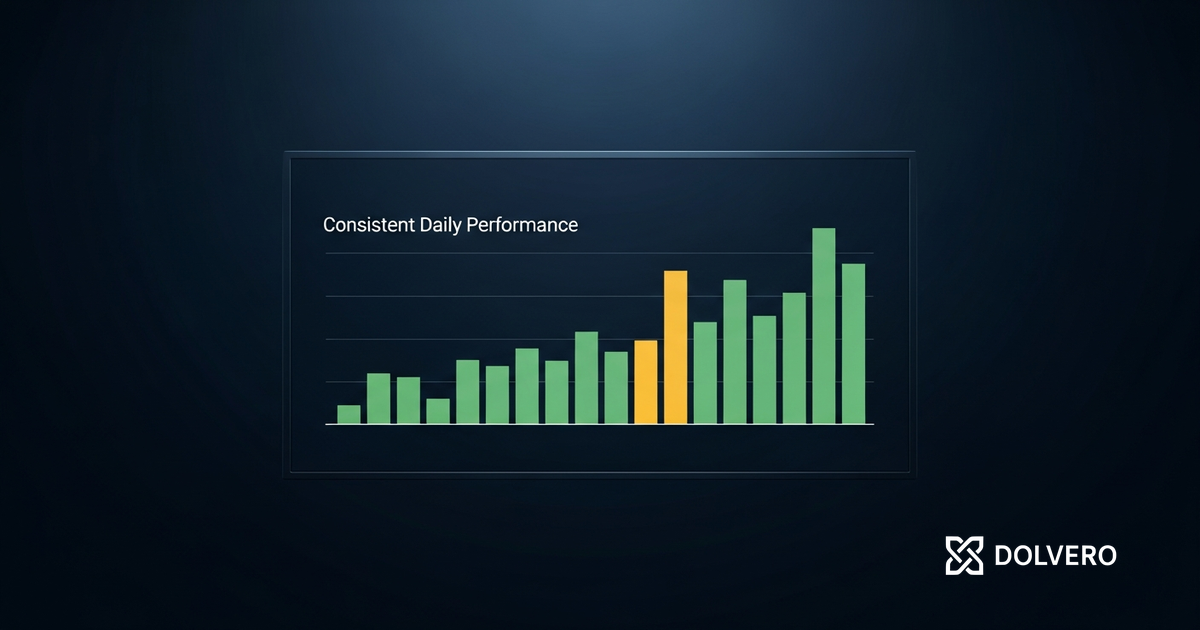
The consistency rule protects both the firm and the trader, although most traders only see the restriction when they first encounter it. From the firm's perspective, the rule serves as a signal quality filter. A trader whose profit comes predominantly from one or two exceptional days presents a fundamentally different risk profile than a trader whose profit is distributed across many sessions. The first trader may have been right for reasons that are not repeatable. The second trader is demonstrating process — and process is what scales.
From the trader's perspective, the rule enforces a habit that most profitable traders already follow voluntarily: diversifying your P&L across sessions. A trader who generates 80% of their monthly profit on a single day is, by definition, dependent on that day occurring. If it does not — if the setup does not appear, or the market conditions shift — the entire month's performance collapses. A trader whose daily contributions are more evenly distributed can absorb multiple average days, a few losing days, and still finish the period profitably.
There is also a psychological benefit that is less obvious. Traders who know they need consistency across sessions are less likely to overtrade on a single "hot" day, less likely to size aggressively because they "feel good" about a particular session, and less likely to chase outsized returns that create the very drawdown events that end accounts. The consistency rule, in practice, functions as a built-in governor on impulsive behaviour.
How the Calculation Works: Step by Step
Let us walk through a concrete example to make the arithmetic completely clear.
Imagine a trader has completed 15 trading days on an Instant Funding account. Their daily profit and loss record looks like this:
- Day 1: +$320
- Day 2: +$180
- Day 3: -$90
- Day 4: +$410
- Day 5: +$50
- Day 6: +$275
- Day 7: -$150
- Day 8: +$380
- Day 9: +$190
- Day 10: +$260
- Day 11: -$80
- Day 12: +$340
- Day 13: +$120
- Day 14: +$200
- Day 15: +$310
Total realised profit: $2,715 (summing only the profitable days: $3,035 gross profit minus $320 in losses, but the consistency rule uses total net profit = $2,715).
The 15% threshold: $2,715 x 0.15 = $407.25.
The trader's best single day was Day 4 at +$410. That is $410 / $2,715 = 15.1% of total profit. The trader is marginally non-compliant — Day 4 exceeds the threshold by $2.75.
What happens next? The trader has two options. First, they can continue trading profitably on subsequent days. If total profit rises to $2,734 or more, the threshold rises to $410 and Day 4 drops below 15%. A single additional profitable day of just $19 would solve the problem. Second, the trader can simply wait — the rule resolves itself as long as the trader continues to trade consistently. There is no penalty for being temporarily non-compliant. The only restriction is that payouts cannot be processed until compliance is achieved.
Common Scenarios That Trigger Non-Compliance
The Early Big Day
The most common trigger is a strong day early in the account's life. If your first trading day yields $500 and your total profit is $500, that single day is 100% of your track record. Every subsequent day of trading reduces that percentage, but it takes time. If you follow Day 1 with ten more days averaging $150 each, your total rises to $2,000 and Day 1 becomes 25% — still above 15%. You need your cumulative total to reach approximately $3,334 before Day 1 drops to compliance.
The lesson is not to trade poorly on your first few days. The lesson is to size positions consistently from the start. If your average daily target is $200-300, do not aim for $500 on Day 1 simply because you see a strong setup. Take it, but size it as you would any other day.
The News Day Windfall
Major economic releases — NFP, CPI, rate decisions — can produce outsized moves. A trader who catches a major move on a news day might book $800 in profit when their average day is $200. That single session becomes a compliance issue. Remember that Dolvero enforces a ±30-minute news trading restriction, which means you should not be positioned through the announcement itself. But the post-news directional move, traded 30+ minutes after the release, is entirely permissible — and these moves can be large.
The solution is straightforward: on days when the market is giving you exceptional opportunities, scale your position size down rather than up. If your normal position is 1.0 lot, consider trading 0.5 lots during post-news volatility. You will still capture the directional move, but your absolute dollar P&L stays within a range that will not disrupt your consistency profile.
The Recovery Spike
After a losing streak, many traders feel pressure to "make it back." They increase size, take additional setups, and push harder than usual. If the recovery day works, the result is a single day that dwarfs the P&L of every other session — creating exactly the consistency violation the rule is designed to prevent. Resist the temptation to recover losses in a single session. The Instant Funding rules do not penalise losing days — but they do penalise concentrated winning days.
Strategies for Staying Compliant
Set a Daily Profit Target and Stop
The single most effective compliance strategy is setting a daily profit target that is consistent with the 15% rule. If your monthly target is $2,000, your daily average over 20 trading days is $100. A daily profit cap of $300 would represent 15% of $2,000 — exactly at the threshold. Practically, aim to cap your best days at roughly $250-280 to leave room for the mathematics to work in your favour.
This does not mean you must stop trading the moment you hit $250 in a session. It means that once you reach that level, you should reduce size dramatically, switch to observation mode, or close your platform. The additional $50 you might capture by continuing to trade is not worth the compliance risk.
Equalise Position Sizing Across Sessions
Consistency in position sizing directly produces consistency in P&L distribution. If you trade the same lot size every day, your winning days and losing days will naturally cluster around similar absolute values. The traders who violate the consistency rule most frequently are those who vary their position size dramatically based on "conviction" — trading 2.0 lots on setups they feel strongly about and 0.5 lots on everything else. This conviction-based sizing is the enemy of consistency rule compliance.
Track Your Consistency Ratio Daily
After each trading day, calculate your current consistency ratio: best single day divided by total profit. If you are approaching 13-14%, you know that your next session needs to be moderate. If you are at 8-9%, you have substantial headroom. This two-second calculation at the end of each session is the single most effective preventive measure. You can monitor this in real time through the Live Ledger.
Front-Load Moderate Days
In the early days of an Instant Funding account, trade conservatively. Build a base of 5-10 moderate days before allowing yourself to pursue larger moves. If your first ten days all show profits between $100 and $250, your total might be $1,500 with a best day of $250 — that is 16.7%, slightly high, but one more $200 day brings it to 14.7%. If your first day is $500 and the next four are $100 each, your total is $900 and your best day is 55%. It takes many sessions to dilute a dominant early day.
What Happens at Payout Time
When you submit a payout request, the system evaluates all account conditions including the consistency rule. If any single day exceeds 15% of total profit, the payout is held until compliance is achieved. Your account remains active — you can continue trading, which is typically the fastest path to resolving non-compliance since additional profitable days raise the total and reduce the percentage of the outlier day.
There is no penalty, no account restriction, and no breach associated with being temporarily non-compliant. The rule is a payout condition, not a termination condition. Your account is never closed because of a consistency violation — it simply means you need to continue trading until the numbers even out.
The Consistency Rule in Context
The 15% consistency rule interacts with the other Instant Funding parameters to create a cohesive risk framework. The 2% daily drawdown limit caps your worst days. The 5% trailing drawdown caps your cumulative losses. The 10 minimum profitable trading days requirement ensures a minimum sample size. And the consistency rule caps your best days relative to the total.
Together, these rules reward a specific type of trader: one who generates steady, moderate returns across many sessions with controlled drawdowns. This is not an accident — it is the only trading profile that scales reliably with real capital. A trader who can do this on a $25,000 account can do it on a $50,000 account, on a $100,000 account, and — through Dolvero's scaling plan — on progressively larger allocations over time.
If you have a consistent edge and the discipline to size positions uniformly, the 15% rule will never be a problem. It only becomes a constraint for traders whose profitability depends on occasional large wins — and those traders, statistically, do not survive the drawdown limits long enough to request a payout regardless.
Review the full Instant Funding ruleset on the rules page, check current account pricing, and when you are ready to begin, start your Instant Funding account here.