


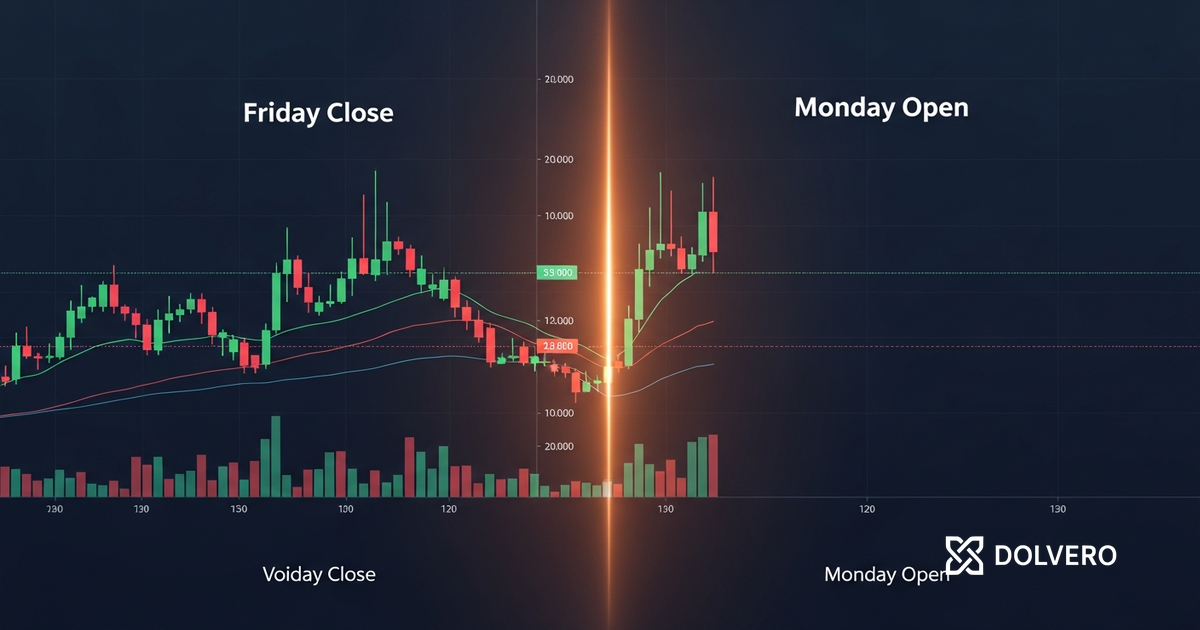
Every Friday afternoon, a scenario plays out across thousands of prop trading accounts worldwide: traders scramble to close positions before the weekend cutoff, frustrated that they cannot hold a perfectly good swing trade through Saturday and Sunday. The reaction is understandable. If your technical analysis tells you that EUR/USD is headed 200 pips higher over the next five days, being forced to close on Friday and re-enter on Monday feels like a constraint that costs you money.
But the no-weekend-holding rule is not arbitrary. It is one of the most important risk management protections in prop trading, and understanding why it exists will change how you think about it. This article explains the specific risk that weekend gaps create, why prop firms treat that risk differently than individual retail accounts, and how Dolvero's optional weekend holding addon provides a path for experienced traders who want to hold through the weekend while still managing the firm's risk exposure.
What Happens to Markets Over the Weekend
Forex, commodities, and index markets close on Friday afternoon and reopen on Sunday evening (or Monday morning, depending on the market and your timezone). During the approximately 48-hour closure, no trading occurs on the primary exchanges — but the world does not stop. Geopolitical events, natural disasters, elections, central bank emergency decisions, major corporate announcements, and other market-moving developments can and do occur while markets are closed.
When markets reopen, prices adjust to reflect everything that happened during the closure. This adjustment is not smooth — it manifests as a "gap," where the opening price on Sunday/Monday is significantly different from the closing price on Friday. These gaps can be small (a few pips on major forex pairs during quiet weekends) or enormous (hundreds of pips following a major geopolitical event or surprise economic announcement).
The critical property of a gap is that it bypasses all stop losses. If EUR/USD closes at 1.0850 on Friday and opens at 1.0750 on Sunday due to a weekend event, a stop loss set at 1.0820 will not execute at 1.0820. It will execute at 1.0750 — the first available price — resulting in a loss 70 pips larger than the trader planned. On a standard lot, that is an additional $700 of unplanned loss. On multiple lots, the figures scale rapidly.
Why This Risk Is Different for Prop Firms
An individual retail trader can choose to accept gap risk as part of their strategy. They are risking their own capital, and the decision to hold through a weekend is a personal risk tolerance choice. A prop firm is in a fundamentally different position: it is allocating capital across hundreds or thousands of funded accounts simultaneously. The firm's aggregate exposure to weekend gap risk is the sum of all positions held across all accounts.
Consider a scenario where 200 funded traders are each holding a 1-lot long position on GBP/USD going into the weekend. The firm's aggregate exposure is 200 lots. If a geopolitical event causes GBP/USD to gap down 150 pips on Sunday evening, the aggregate loss across those 200 accounts is approximately $300,000 — and that loss occurs before any risk management mechanism can activate. No stop loss, no daily loss limit, no drawdown calculation can prevent it. The loss is instantaneous and unavoidable.
This is why the default rule at Dolvero — and at most serious prop firms — requires all positions to be closed before the weekend. It is not a constraint on the trader's strategy. It is a constraint on the firm's aggregate exposure to an unhedgeable risk event. Full details are on the rules page.
How the Friday Close Works in Practice
The no-weekend-holding rule requires that all positions be closed before the end of the Friday trading session. The specific cutoff time is defined by the MT5 server time and is documented in your account specifications. In practice, the cutoff is typically 15-30 minutes before the market close to allow for orderly execution.
If you have open positions as the cutoff approaches, you are responsible for closing them. Dolvero may also enforce automated position closure at the cutoff time as a safety mechanism — but relying on automated closure is not recommended, as the execution price may be less favourable than if you close the position yourself during active trading hours.
The best practice is to close all positions well before the cutoff — ideally during the London or early New York session on Friday, when liquidity is highest and spreads are tightest. Closing positions in the final minutes of the Friday session often means dealing with wider spreads, lower liquidity, and suboptimal fills.
The Impact on Swing Trading Strategies
The no-weekend-holding rule has the most significant impact on swing traders — those who hold positions for multiple days or weeks based on higher timeframe analysis. If your strategy involves holding a position from Tuesday to the following Wednesday, the weekend interrupts that hold period. You must close on Friday and decide on Monday whether to re-enter.
This creates three practical considerations:
- Re-entry cost: Closing on Friday and re-opening on Monday means paying the spread twice instead of once. On EUR/USD this cost is minimal; on exotic pairs or certain commodities, it can be material.
- Gap direction: If the market gaps in your favour over the weekend, you miss that move because you were flat. Conversely, if it gaps against you, you avoided a loss that could have been larger than your planned stop.
- Strategy adaptation: Some traders adapt their swing strategies by shifting to a "Monday entry, Friday exit" framework that works within the no-weekend-holding rule. Others shorten their timeframes during evaluation periods and return to multi-day holds once they have a personal account for that strategy.
The no-weekend-holding rule does not prevent swing trading. It constrains the holding period to Monday-Friday, which is a meaningful limitation but not a fatal one for most swing strategies.
The Weekend Holding Addon
Dolvero offers an optional weekend holding addon for traders who want to hold positions through the weekend. This addon is available as a paid addition to your account and modifies the default no-weekend-holding rule to allow positions to remain open over Saturday and Sunday.
How the Addon Works
When the weekend holding addon is activated on your account, the Friday close requirement is lifted. You can hold positions through the weekend just as you would on a personal trading account. The position remains open, your stop loss remains active (though it will only execute at the Sunday/Monday reopening price if gapped), and your equity is updated when the market reopens.
What Does Not Change
It is important to understand what the addon does not change:
- Drawdown limits still apply: If a weekend gap causes your equity to breach the drawdown limit, the account is terminated. The addon gives you permission to hold — it does not give you protection from gap risk.
- Daily loss limits still apply: The daily loss limit calculation on Monday morning includes any gap loss from the weekend opening. A large adverse gap on Sunday evening can consume your entire daily loss allowance before you place a single trade on Monday.
- Risk per trade still applies: The 2% maximum risk per trade rule applies at all times, including positions held over the weekend. If a weekend gap moves against your position, the resulting loss may exceed the 2% threshold — which is precisely the risk the default rule is designed to prevent.
Who Should Use the Addon
The weekend holding addon is appropriate for experienced traders who meet these criteria:
- Swing strategy with demonstrated edge: Your strategy requires multi-day holds and has a documented track record showing that weekend holds contribute positively to overall performance.
- Risk-adjusted position sizing: You size positions for weekend holds smaller than intraweek positions, explicitly accounting for gap risk. A position that risks 2% intraweek might be sized at 0.5-1% when held over a weekend.
- Awareness of event calendars: You monitor geopolitical risk, central bank schedules, and weekend event risk before deciding to hold. Some weekends are high-risk (major elections, G7 summits, geopolitical tensions); others are low-risk. The decision to hold should be informed, not automatic.
- Sufficient drawdown buffer: You have enough drawdown headroom to absorb a worst-case weekend gap without breaching your account. If your available drawdown buffer is less than 5%, holding over the weekend is inadvisable regardless of the addon.
Addon pricing and activation details are available on the pricing page.
Historical Weekend Gaps: What the Data Shows
To put weekend gap risk in perspective, here are some characteristics of weekend gaps across major forex pairs based on historical data:
- EUR/USD: Average weekend gap is 5-15 pips. Gaps exceeding 50 pips occur approximately 2-3 times per year. Gaps exceeding 100 pips are rare but have occurred during eurozone crises and major geopolitical events.
- GBP/USD: Average gap is 10-25 pips, with Brexit-related weekends producing gaps of 100-200+ pips.
- USD/JPY: Average gap is 5-20 pips, with gaps during Bank of Japan emergency meetings or major earthquake events exceeding 100 pips.
- Gold (XAU/USD): Average gap is 2-5 USD. During Middle East escalation weekends, gaps of 20-50 USD have occurred — equivalent to 200-500 pips on a standard lot.
The takeaway is not that weekend gaps are always large — on most weekends, they are manageable. The takeaway is that when they are large, they are large enough to breach a prop trading account in a single event. The no-weekend-holding rule protects you from the worst-case scenario, even though that scenario is infrequent.
Practical Friday Routine for Traders Without the Addon
If you are trading without the weekend holding addon — which is the default and the recommended approach for most traders — here is a practical Friday routine that eliminates weekend risk while preserving trading opportunities:
- Morning review: Check all open positions and calculate their current P&L. Identify which positions you intend to close today and at what levels.
- Mid-session assessment (London/NY overlap): If you have positions that are near their profit targets, consider whether it is better to take partial profits now with strong liquidity or to hold for a few more hours. The answer should almost always favour taking profits during the overlap session rather than holding into the illiquid final hours.
- Two hours before cutoff: Begin closing all remaining positions. Do not wait for the last 30 minutes. Liquidity thins dramatically in the final hour of Friday trading, and spreads widen on most instruments. Closing early — even at a slightly less favourable price — is almost always better than closing in the final minutes with poor execution.
- Post-close review: Once all positions are flat, review your weekly performance. Calculate your drawdown buffer, your P&L for the week, and your position relative to the evaluation or funded account targets. Use this information to plan your Monday session before the weekend begins.
This routine takes approximately 10-15 minutes of deliberate attention beyond your normal trading day. It ensures clean compliance with the no-weekend-holding rule and provides a structured end to the trading week that many traders find psychologically beneficial — a clean break between trading and rest.
Making the Decision
The default no-weekend-holding rule is the safer choice for the majority of traders. It eliminates an entire category of uncontrollable risk and constrains your losses to scenarios where you are actively monitoring the market and can respond in real time. For intraday and short-term swing traders, the rule has minimal impact on strategy performance.
The weekend holding addon is a tool for experienced swing traders who understand gap risk, size accordingly, and have a strategy that genuinely benefits from multi-day holds including weekends. If that describes you, the addon is available. If you are uncertain, trade without it for your first few months and review your performance data. If your strategy consistently requires weekend holds to capture its edge, activate the addon with full awareness of the additional risk it introduces.
Read the full rules, explore how the account types work, and check pricing including addon options. Start your evaluation at app.dolvero.com/start and track your progress on the Live Ledger.