



Passing a prop firm challenge is mostly a matter of not failing it. That sounds like a slogan until you open the enforcement records. Between 12 April and 9 November 2026, 2,155 Dolvero accounts had at least one breach, and half of them broke the daily loss limit, more than any other rule. The most common single reason an account ends is a day that ran past what the day allowed, and loss-limit breaches peak at 13:00 UTC. This guide starts from that data and turns it into seven rules and a 10-day plan on a $100,000 2-Step.
- The Daily Loss Limit appears in 50.1% of breached Dolvero accounts, more than any other rule. Trailing Drawdown follows at 31.5%, News Trading at 22.1%, Prohibited Strategies at 10.9% and the 2% cap per trade idea at 10.2%.
- Loss-limit breaches cluster at 13:00 UTC: about 13% of them fall in that single hour, against about 4% for an average hour, and 12:00 to 14:00 UTC together carry about 19%.
- Daily loss and drawdown are measured on equity, so open positions count at live prices. Position size decides most of the rows in the breach table.
- A qualifying day closes at least 0.5% of the starting balance in profit, and each 2-Step or 1-Step phase needs five of them. A plan needs a handful of clean days, not twenty.
- Seven rules follow from the data: size from the daily limit, treat 12:00 to 14:00 UTC as the highest-risk window, size gold in dollars, never hedge, be flat before Friday, count open risk, stay under the 2% cap.
- Dolvero has no time limit on any phase, so the plan below has no deadline, and the 2-Step's 10% maximum drawdown is static, so a slow start never moves the floor against you.
- Accounts with a breach
- 2,15512 April to 9 November 2026
- Daily Loss Limit share
- 50.1%of breached accounts
- Busiest breach hour
- 13:00 UTCabout 13% of loss-limit breaches
- 12:00 to 14:00 UTC
- about 19%of loss-limit breaches
- News Trading share
- 22.1%of breached accounts
- Qualifying day
- 0.5%closed profit, 5 days per phase
What actually ends challenges
The table below is the share of breached accounts by rule, across the standard Dolvero programs from 12 April to 9 November 2026 (2,155 accounts with at least one breach that stood). An account can appear under several rules, so the shares add up to more than 100%. The important column is the last one: for every rule there is one concrete habit that keeps you clear of it.
| Rule | Share of breached accounts | What it means in practice | What keeps you clear of it |
|---|---|---|---|
| Daily Loss Limit | 50.1% | Equity, open positions included, fell below the day's starting balance minus the daily limit (5% on the 2-Step, 3% on the 1-Step, 2% to 3% on Instant Funding depending on size). | Size every trade from the daily limit, not from the profit target, and count every open position toward it. |
| Trailing Drawdown | 31.5% | On the 1-Step and Instant Funding, equity fell below a floor that had risen with earlier profit. | Tighten risk after new highs; a pullback counts the same as a loss. |
| News Trading | 22.1% | A position was opened within 10 minutes before or after a High Impact event in the Dolvero economic calendar, on an instrument that event affects. | Read the calendar in UTC and place no new entry in the window. A position already open may be held through the release and closed. |
| Prohibited Strategies | 10.9% | Hedging or offsetting positions, copying signals, coordinating accounts, latency or feed arbitrage, tick scalping, gambling-style one-sided bets. | One direction per instrument, one idea at a time, your own decisions on your own account. |
| Risk per Trade (2% cap) | 10.2% | A single trade idea produced a realised loss above 2% of the current balance on an evaluation. | Plan at 1% per idea and place the stop with slippage in mind; the No Risk Limit add-on (+25%) removes the cap for traders who need it. |
| Weekend Holding | 8.2% | A position was open at some moment on Saturday or Sunday. | Close before the Friday market close, or take the Weekend Holding add-on (+15%). |
| Inactivity | 5.1% | Instant Funding: no trade for seven consecutive days. | Any trade, opening or closing, resets the clock. |
| Max Drawdown | 3.2% | Equity fell below the fixed floor, 10% under the starting balance on the 2-Step. | Reduce size after a losing day instead of sizing up to recover. |
| One-Sided Betting | 1.3% | Passing on one oversized bet rather than on a repeatable process. | The 2% cap and the 0.5% day definition keep a plan inside the rule by construction. |
Read the table from the trader's side and it collapses into a short list: position size decides the first, second, fourth, fifth and eighth rows, the calendar decides the third, sixth and seventh, and your own rules for each trade decide the rest. That is why the plan later in this article is built around size and time, not around a strategy. No add-on removes the daily and maximum limits, because they are what the funded capital is priced on.
When accounts break: the hour of day
Loss-limit breaches (daily loss, trailing and maximum drawdown, and the 2% cap) are not spread evenly across the day. The busiest hour is 13:00 UTC, with about 13% of the 2,048 such breaches recorded between 12 April and 9 November 2026, roughly three times what an average hour carries. The two hours from 12:00 to 14:00 UTC carry about 19%. That window coincides with the US data releases at 08:30 Eastern Time, which is 12:30 UTC during daylight time and 13:30 UTC in winter, and with the run-up to the US equity open. The records show when breaches happen, not why, but the practical reading is simple: a position sized for a quiet London morning is the same position at 13:30 UTC, and the price can move a long way while you decide what to do.
| Window (UTC) | Share of loss-limit breaches | What is happening |
|---|---|---|
| 13:00 to 13:59 | about 13% | US data releases at 13:30 UTC in winter, follow-through of the 12:30 UTC releases in summer |
| 12:00 to 13:59 | about 19% | The US pre-open and data block |
| Other 22 hours | about 81% | Asian and London sessions, US afternoon and evening |
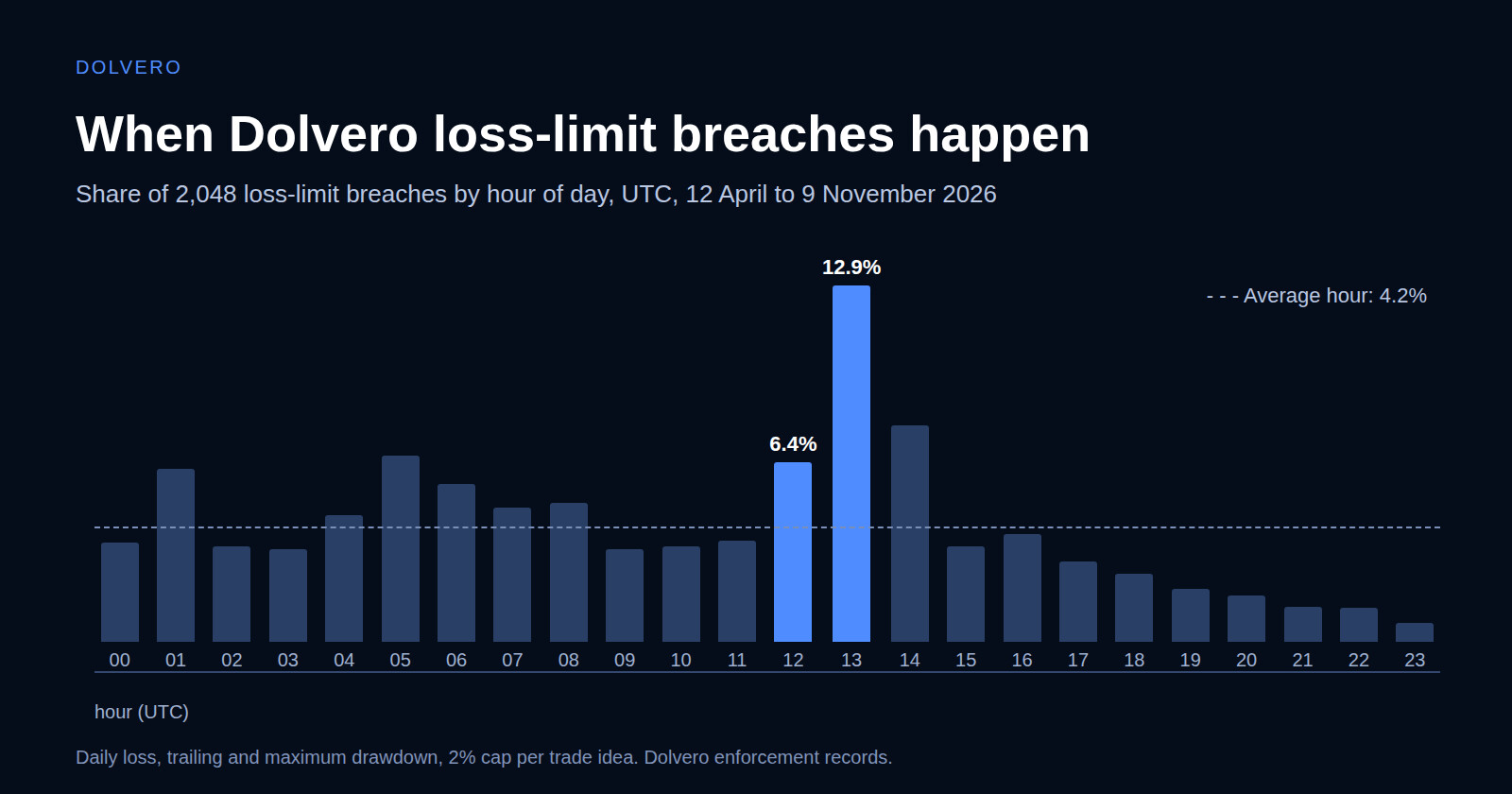
The News Trading rule and the clock overlap here. No new position may be opened from 10 minutes before to 10 minutes after any High Impact event in the Dolvero economic calendar, on the instruments that event affects, and 22.1% of breached accounts hit that rule. A position that is already open may be held through the release and closed, so closing is never the breach. Read the calendar in the same UTC the trade log uses: one hour of difference between your local time and UTC is enough to put an entry inside the window.
How the qualifying-day rule shapes a plan
A qualifying day at Dolvero is a day that closes with at least 0.5% of the starting balance in realised profit. On the 2-Step and 1-Step each phase needs five of them; on Instant Funding the first payout needs ten profitable days. Days below 0.5% still count for your equity, they just do not count toward the five. There is no time limit, so a phase can take a week or two months, and neither is better or worse.
The arithmetic explains why a handful of clean days is enough. Phase one asks for 10%. Five qualifying days at 2% each reach it exactly; ten days at 1% reach it with every one of them qualifying twice over. Neither route needs a single trade near the 2% cap, and neither needs a day anywhere near the 5% daily limit. A plan built from modest, repeated profit days sits well inside every limit, and that is the profile the seven rules below are designed to produce.
A day only counts when it closes at least 0.5% in profit, so the minimum cannot be met with five token trades. In exchange, no day of tiny profit can be used against you either: a $200 day on a $100,000 account is neither a qualifying day nor a problem. Combined with no time limit and no consistency rule on the 2-Step, the requirement rewards steady, modest profit days.
Seven rules the data writes for you
1. Size from the daily limit, not from the target
On a $100,000 2-Step the daily limit is $5,000. At 1% risk per idea you can lose five trades in a row before the day ends; at 0.5% you can lose ten. A simple illustration, not a case from the records: a $5,000 Instant Funding account has a 3% daily limit, so $150 of room. A position sized for a $200 move is sized for a day that does not exist on that account. Work from the room you have: decide the dollar loss you accept first, then size the trade to it.
2. Treat 12:00 to 14:00 UTC as the highest-risk window
About one loss-limit breach in five lands in this block. There are two honest ways to handle it. Be flat before 12:00 UTC and re-enter after 14:00 UTC, which also keeps you clear of the 10-minute news window around the 12:30 and 13:30 UTC releases. Or trade it at half your normal size, and place no new entry within 10 minutes of a High Impact release. A position that is already open may be held through the release and closed, but the loss it can take in those minutes still counts against the daily limit.
3. Size gold in dollars, never in lots
Gold moves in large dollar steps, and the lot size is where the risk hides. On a standard 100-ounce contract (check the contract specification in your terminal), one lot moves $100 for every $1 of price, so 1.69 lots of gold is a $169 swing for a $1 move. Work backwards: decide the dollar loss you accept, divide it by the stop distance in dollars, and that is your lot size. A $250 risk with a $5 stop is 0.5 lots, and the same method works on any instrument.
4. Never hedge, not even 0.01 lots
Hedging or offsetting positions on the same or correlated instruments is prohibited on Dolvero, on one account and across accounts, and the rule states no minimum size. If you want to reduce a position, close part of it. If you are unsure about a correlated pair, for example long gold and short silver, treat it as a hedge and pick one.
5. Be flat before the Friday close
No position may be open at any moment on Saturday or Sunday, including crypto CFDs that quote at the weekend, and closing before Friday 16:55 New York time is your responsibility. Put a hard alarm two hours before the close and close everything, or add Weekend Holding at checkout (+15%), which lifts the rule for that account. Weekend gaps are the reason for the rule: they can breach a daily limit before you can react. Swing traders should decide this before buying the challenge, not on Friday afternoon.
6. Count open risk, not closed losses
Daily loss and maximum drawdown are measured on equity, so every open position counts at its live price. Stacking is the quiet version of oversizing: no single trade is large, but ten positions open on the same instrument add up. Before each new entry, add up the stop-loss risk of everything already open and treat that total as spent. If the room left to the daily limit is smaller than the stop of the trade you are about to place, the trade does not fit.
7. Respect the 2% cap per trade idea
Evaluations cap each trade idea at a realised loss of 2% of the current balance, and 10.2% of breached accounts hit it. On a $100,000 account that is $2,000 per idea; on $25,000 it is $500. Slippage can push a realised loss past the intended stop, so place stops conservatively. The plan in this article uses at most half of the cap. If your method genuinely needs larger single positions, the No Risk Limit add-on (+25%) removes the cap on the 2-Step and 1-Step while the daily and maximum limits stay in place. For most traders the cap is a guard rail: it makes one-sided betting impossible and keeps any single mistake at 40% of the daily allowance.
A 10-day plan template on a $100,000 2-Step
The template turns the rules into numbers you can put next to the chart. It assumes a $100,000 2-Step with the standard 5% daily limit, 10% static maximum drawdown and 2% cap per idea. Goals are closed profit for the day; the two loss numbers are hard stops. Every day is inside the allowance by a wide margin: the largest permitted loss day is $2,000, which is 40% of the daily limit, and the largest single idea is $1,000, half the cap.
| Day | Closed-profit goal | Max loss for the day | Max risk per idea | Cumulative goal |
|---|---|---|---|---|
| 1 | +$500 (0.5%) | $1,000 (1%) | $500 | $500 |
| 2 | +$500 (0.5%) | $1,000 (1%) | $500 | $1,000 |
| 3 | +$1,000 (1%) | $1,500 (1.5%) | $750 | $2,000 |
| 4 | +$1,000 (1%) | $1,500 (1.5%) | $750 | $3,000 |
| 5 | +$1,000 (1%) | $1,500 (1.5%) | $750 | $4,000 |
| 6 | +$1,000 (1%) | $1,500 (1.5%) | $750 | $5,000 |
| 7 | +$1,000 (1%) | $1,500 (1.5%) | $750 | $6,000 |
| 8 | +$1,500 (1.5%) | $2,000 (2%) | $1,000 | $7,500 |
| 9 | +$1,500 (1.5%) | $2,000 (2%) | $1,000 | $9,000 |
| 10 | +$1,000 (1%) | $2,000 (2%) | $1,000 | $10,000, target reached |
The plan has five operating rules, and they matter more than the numbers.
- Goal reached, screen off. When the day's closed profit reaches the goal, stop. Every goal day is a qualifying day, so ten of them cover the five required with room for days that fall short.
- Max loss reached, day over, next day one tier down. A $1,500 loss on day 5 means day 6 runs on day 1 sizing: $1,000 max loss, $500 per idea. Step back up only after a goal day.
- Cumulative guard at minus 3%. If the account is more than $3,000 below its starting balance, every day runs on day 1 sizing until it is back above. This keeps you a long way from the $90,000 floor, which on the 2-Step never moves.
- No trading 12:00 to 14:00 UTC on release days, flat before Friday close. Not a preference, a calendar entry. Check the Dolvero economic calendar each morning in UTC.
- Missed days are added to the end. There is no deadline on any Dolvero phase. A flat day or a day below 0.5% costs nothing but time.
Phase two asks for 5%, so run the same template with every goal halved and the loss limits unchanged. Instant Funding has no target; the same daily structure works with the loss numbers scaled to its 2% daily limit, and it has the added benefit of producing the ten 0.5% days the first payout requires.
The mistakes the record repeats
| Mistake | What the record shows | What to do instead |
|---|---|---|
| Sizing to the target | Daily Loss Limit in 50.1% of breached accounts | Size from the daily limit; keep the worst day at 40% of it |
| Stacking small trades | Open positions count at live equity toward the daily limit | Add up open stop-loss risk before every entry |
| Full size into 13:00 UTC | About 13% of loss-limit breaches in that hour, about 19% across 12:00 to 14:00 UTC | Flat or half size in the block; re-enter after 14:00 UTC |
| Calendar in local time | News Trading in 22.1% of breached accounts | Read the Dolvero calendar in UTC and set alarms 15 minutes before events |
| Gold sized in lots | One lot of gold moves $100 per $1 on a 100-ounce contract | Dollar risk divided by stop distance equals lot size |
| "Locking in" with an opposite position | Prohibited Strategies in 10.9% of breached accounts | Close part of the position; never hold both directions |
| Leaving a Friday position open | Weekend Holding in 8.2% of breached accounts | Alarm two hours before the close, or the Weekend Holding add-on |
| One big trade to finish | Risk per Trade in 10.2%, One-Sided Betting in 1.3% | Stay under 1% per idea; the last 1% is a normal day, not an event |
| Ignoring the trailing floor on 1-Step and Instant | Trailing Drawdown in 31.5% of breached accounts | After every new high, treat a pullback as a loss and cut size |
| Walking away from an Instant account | Inactivity in 5.1% of breached accounts | One trade a week resets the 7-day clock; closing a position counts |
Where Dolvero stands out
Most of what makes a challenge passable is on the trader's side of the screen. The part that is on the firm's side is whether the rules give a careful plan room to work, and whether they stay put once you have started.
- Time limit
- Noneon every phase, the plan has no deadline
- 2-Step drawdown
- 10% staticthe floor never moves against you
- Rules
- Lockedfrom day one by the signed Trading Rules Agreement
- Payout release
- 1.9 haverage across 348 payouts, 100% inside 24 h
- Evaluation fee
- Refundedin full with the second payout
- Add-ons
- Publishedweekend holding, no risk limit, profit split, relaxed risk, each with its price
The restrictions in this article each have a documented reason, and most have a documented exit: the weekend rule is lifted by Weekend Holding, the 2% cap by No Risk Limit. The news window has no add-on, and it is narrow: 10 minutes either side of a High Impact release, on the instruments it affects, with open positions free to be held and closed. No add-on removes the daily and maximum limits, because they are what the funded capital is priced on. A full rule-by-rule comparison with ten other firms is in Prop Firm Rules Compared 2026, and the mechanics of each limit are in Daily, Max and Trailing Drawdown Explained.
Frequently asked questions
How do you pass a prop firm challenge?
By keeping every day inside the daily loss limit until enough qualifying days add up to the target. On Dolvero's enforcement record, 50.1% of breached accounts broke the daily limit, more than any other rule, so position size decides a large part of the outcome. Size from the daily limit, count open positions, place no new entries in the news window and stay under the 2% cap.
What is the most common reason traders fail a prop firm challenge?
At Dolvero it is the Daily Loss Limit, present in 50.1% of breached accounts, followed by Trailing Drawdown at 31.5% and News Trading at 22.1%. The busiest hour for loss-limit breaches is 13:00 UTC.
How many days does it take to pass a Dolvero 2-Step?
Each phase needs at least five qualifying days. There is no time limit on any phase, so the calendar length is up to you. A qualifying day closes at least 0.5% of the starting balance in profit.
What counts as a trading day at Dolvero?
A day on which closed profit is at least 0.5% of the starting balance. Days with smaller profit or a loss do not count toward the five, but they do not hurt you either; there is no consistency rule on the 2-Step and 1-Step.
What is the best time of day to trade a prop firm challenge?
The record does not say when traders make money, but it says when loss limits are breached: about 19% of loss-limit breaches fall between 12:00 and 14:00 UTC. Trading the London morning and the US afternoon at normal size, and the 12:00 to 14:00 UTC block flat or at half size, keeps you out of the densest part of the data.
Can I trade gold on a Dolvero challenge?
Yes, on the CFD programs. Gold moves in large dollar steps, so size it by dollar risk divided by stop distance, keep both directions out of the account and place no new entries within 10 minutes of a High Impact release that affects it.
Every limit in this plan is listed before you buy
The rules page lists every parameter for every model, and every add-on with its price, so you can build your plan against the real numbers.
- Dolvero: Trading rules and FAQ (daily loss limit, maximum drawdown, 2% cap, qualifying day definition, news and weekend rules, add-ons), Transparency page and public rules changelog (348 payouts, 1.9 h average release, 100% inside 24 h, as of 9 November 2026)
- Dolvero enforcement records, standard programs, aggregate values from 12 April to 9 November 2026: 2,155 accounts with at least one breach, share of breached accounts by rule, 2,048 loss-limit breaches by hour of day (UTC). Aggregates only, no individual accounts.
- U.S. Bureau of Labor Statistics: Employment Situation release schedule, release time 08:30 AM Eastern Time (12:30 UTC during daylight time, 13:30 UTC in standard time)