


The cheapest way to a $100,000 funded account at Dolvero is the 2-Step evaluation at a list price of $549. The cheapest way measured per dollar of buying power is different: start at $50,000 for $299 and let scaling do the work, because a funded account that qualified for the full 25% increase at every three-month review would pass $122,000 inside a year. Scaling is not automatic, it depends on consistent profitability and on keeping to the rules, so treat that figure as the best case rather than a plan. Add-ons move both numbers, in one case downward. And both go to zero when the fee is refunded in full with your second payout. This guide turns every route, every add-on percentage and every failure scenario into dollars.
- List prices for a $100,000 Dolvero account: 2-Step $549, 1-Step $689, Instant Funding $749. Same capital, three different pieces of work to get it.
- Add-ons are percentages of the evaluation fee. On the $549 2-Step, +15% is $82.35, +20% is $109.80 and +25% is $137.25. Relaxed Risk is the one that subtracts: 10% off, or $54.90.
- Cost per $1,000 of buying power: $5.49 on the 2-Step, $6.89 on the 1-Step, $7.49 on Instant Funding, and $2.45 in the best case, if you buy the $50,000 2-Step and every quarterly scaling step is granted at the full 25%.
- The fee is refunded in full with your second payout on every challenge type, so a path that reaches funded and stays there has a net cash cost of zero.
- If the first attempt breaches and the second one reaches a second payout, the whole journey nets out at $549, because the refund covers one fee and not the other.
- Dolvero's 2-Step carries no consistency rule, no inactivity rule and no time limit, which is what decides whether a low price stays low once you are trading.
- Cheapest $100K route
- $5492-Step list price
- Per $1,000 of capital
- $5.492-Step, before add-ons
- Fee refund
- 100%with the 2nd payout, every model
- Best case per dollar
- $2.45per $1,000, $50K with full scaling for 12 months
- Add-on range
- -10% to +25%of the evaluation fee
- Scaling
- up to +25%every 3 months, on consistent profit, up to $200,000
Four routes to $100,000, priced
Dolvero sells three products that end in a $100,000 funded account, plus a fourth route that gets there without ever buying a $100,000 evaluation. All prices below are list prices in US dollars, charged once at checkout. Temporary promotions run from time to time and are applied at checkout, so treat these as the ceiling rather than the number you will always pay.
| Route | List price | What you have to do | Shortest realistic path | Per $1,000 of capital |
|---|---|---|---|---|
| 2-Step CFD $100,000 | $549 | 10% then 5% target, 5 qualifying days per phase | Two phases, no time limit | $5.49 |
| 1-Step CFD $100,000 | $689 | 10% target, 5 qualifying days, 6% trailing floor | One phase | $6.89 |
| Instant Funding $100,000 | $749 | No evaluation. Payout gate: 10 profitable days of at least 0.5% before each payout, best day at most 15% of the cycle's net profit | Funded from the first trade | $7.49 |
| $50,000 2-Step, then scaling | $299 | Pass a $50,000 2-Step, then hold consistent profit | Up to $122,000 after 12 months, if every step is granted | $2.45 |
The per-$1,000 column is the honest way to compare a ticket price with a piece of capital. In per-dollar terms the 2-Step costs $0.00549 for every dollar of buying power, which is about half a cent. In its best case the scaling route costs less than half of that, and the reason is simple: you are paying the $50,000 price for capital that can grow once you trade it well. Whether it grows is decided at each review, not at checkout.
A single phase looks like less work, so traders expect it to cost less, yet the 1-Step lists at $689 against $549. The two also differ in the limits: the 2-Step gives 5% daily and a 10% static floor, the 1-Step 3% daily and a 6% trailing floor. The 2-Step asks for more phases from you and gives the widest limits of the three CFD models, which makes it both the cheapest and the most forgiving route to $100,000.
Add-ons, in dollars rather than percentages
Every Dolvero add-on is a percentage of the evaluation fee, added at checkout. On a $100,000 account the base is large enough that the percentages become real money, so it is worth seeing them as amounts before you tick the boxes.
| Add-on | Change | On the $549 2-Step | On the $689 1-Step | On the $749 Instant | What it does |
|---|---|---|---|---|---|
| News Trading | +15% | +$82.35 | +$103.35 | not available | Removes the news window: no new position from 10 minutes before to 10 minutes after a High Impact release on an affected instrument. An open position may always be held and closed. |
| Weekend Holding | +15% | +$82.35 | +$103.35 | +$112.35 | Lets you hold through Saturday and Sunday. |
| Profit Split Boost | +20% | +$109.80 | +$137.80 | not available | 80% becomes 90% once funded. |
| No Risk Limit | +25% | +$137.25 | +$172.25 | not needed | Removes the 2% cap per trade idea. Daily and maximum limits stay. |
| Relaxed Risk | -10% | -$54.90 | 2-Step only | 2-Step only | A discount that also widens the limits: 4% daily and 8% maximum instead of 5% and 10%. |
Relaxed Risk is the line most cost comparisons miss. It is the only add-on with a minus sign, and it is not a downgrade in disguise: the daily limit moves from 5% to 4% and the maximum drawdown from 10% to 8%, in exchange for 10% off the fee. On the $100,000 2-Step that is a configured price of $494.10, which is the cheapest way to hold a $100,000 Dolvero evaluation.
| Configuration of the $100,000 2-Step | Percentage on the fee | Price | Per $1,000 of capital |
|---|---|---|---|
| With Relaxed Risk only | -10% | $494.10 | $4.94 |
| Plain, no add-ons | 0% | $549.00 | $5.49 |
| News Trading only | +15% | $631.35 | $6.31 |
| News Trading and Profit Split Boost | +35% | $741.15 | $7.41 |
| All four additive add-ons | +75% | $960.75 | $9.61 |
Two of those percentages pay for themselves and two do not, and the difference is arithmetic you can do before you buy. Profit Split Boost costs $109.80 and moves 80% to 90%, so it returns its cost as soon as the account produces $1,098 of gross profit, which is 1.1% of a $100,000 account. News Trading and Weekend Holding do not return anything by themselves: they remove a restriction, and they are worth the money only if your method actually needs the window or the weekend.

The cheapest route is not the cheapest ticket
Scaling changes the whole calculation. Every three months a Dolvero funded account may qualify for an increase of up to 25%, based on consistent profitability and adherence to all trading rules. The standard scaling programme goes up to $200,000; growth beyond that is not an entitlement and is possible only by invitation. The table shows the best case, in which every step is granted at the full 25%. The account size compounds, the fee does not.
| Month | Account size if every step is granted | Cumulative fee paid | Per $1,000 of capital |
|---|---|---|---|
| 0, evaluation passed | $50,000 | $299 | $5.98 |
| 3 | $62,500 | $299 | $4.78 |
| 6 | $78,125 | $299 | $3.83 |
| 9 | $97,656 | $299 | $3.06 |
| 12 | $122,070 | $299 | $2.45 |
| 18 | $190,735 | $299 | $1.57 |
The comparison is worth stating plainly. Buying the $100,000 2-Step outright costs $250 more than the $50,000 one and gives you the capital today. Buying the $50,000 one and aiming for scaling costs $250 less and would give you up to 22% more capital after twelve months, if every scaling step is granted. If the money matters more than the timeline, the small account wins. If the timeline matters more, pay the $549 and start.
- Decide what you are optimising. Time to $100,000, or dollars per dollar of buying power. Those two answers point at different products, and almost every argument about which prop firm is cheapest is really an unstated disagreement about this question.
- Pick the model from the rules, then look at the price. The 2-Step gives 5% daily and a 10% static floor. The 1-Step gives 3% and a 6% trailing floor. If a trailing floor does not suit your equity curve, the $140 you save is irrelevant, because you will pay it again on the second attempt.
- Add only the add-ons your method needs. A method that never holds through Friday's close does not need Weekend Holding. A method that never risks more than 2% of the balance on one trade does not need No Risk Limit.
- Check whether Relaxed Risk fits. If your worst day rarely goes past 3%, trading a 4% daily limit instead of 5% costs you nothing and saves 10% of the fee.
What a second attempt does to the number
Any honest cost guide has to price failure, because the list price on the pricing page assumes you pass first time. At Dolvero a further attempt means a further evaluation at its list price; there is no cheaper way to price a breach into your plan than to assume the full ticket again. The refund, which arrives with your second payout, covers the fee for the challenge that reached funded status and not the ones that did not.
| Scenario on the $100,000 2-Step | Cash paid | Refunded at 2nd payout | Net cost | Net per $1,000 |
|---|---|---|---|---|
| Passed on the first attempt, funded, two payouts taken | $549 | $549 | $0 | $0.00 |
| One breach, passed on the second attempt | $1,098 | $549 | $549 | $5.49 |
| Two breaches, passed on the third attempt | $1,647 | $549 | $1,098 | $10.98 |
| Passed, funded, one payout taken and then a breach | $549 | not reached | $549 | $5.49 |
The last row is the one to plan around. The refund is attached to the second payout, and the first payout can be requested 14 days after your first trade on the funded account with the next one 14 days later. That puts the refund roughly four weeks into the funded account, and it means the funded account has to survive those four weeks. A trader who takes the first payout and then sizes up to chase the second one is trading against the refund, not for it.
On the 2-Step no single trade may lose more than 2% of the starting balance, and the daily loss limit is 5%. A $549 evaluation ended by one oversized position is a $549 lesson that can be repeated at will. Sizing inside those two lines, not the ticket price, decides how many evaluations you end up buying.

How to compare the $100,000 price with other firms
List prices and promotions change often, and some firms price in euros, so the exchange rate on the day decides what leaves your account. Open each firm's own pricing page on the day you buy rather than relying on a figure from a review site, ours included, and read what happens to the fee after you pass. Refund mechanics differ by firm and by product, so read the trigger on the firm's own page rather than assuming. Dolvero lists the 2-Step at $549, and the fee comes back in full with your second payout; with Relaxed Risk the configured price is $494.10.
What "cheap" usually hides
A low ticket price becomes an expensive account through four levers: a consistency rule that delays payouts, a cap that limits what you can express, a split that hands back less of the profit, and a time limit or inactivity rule that ends the account for reasons unrelated to trading. Here is where the Dolvero 2-Step sits on each.
| Lever | Dolvero 2-Step | Why it changes the real cost |
|---|---|---|
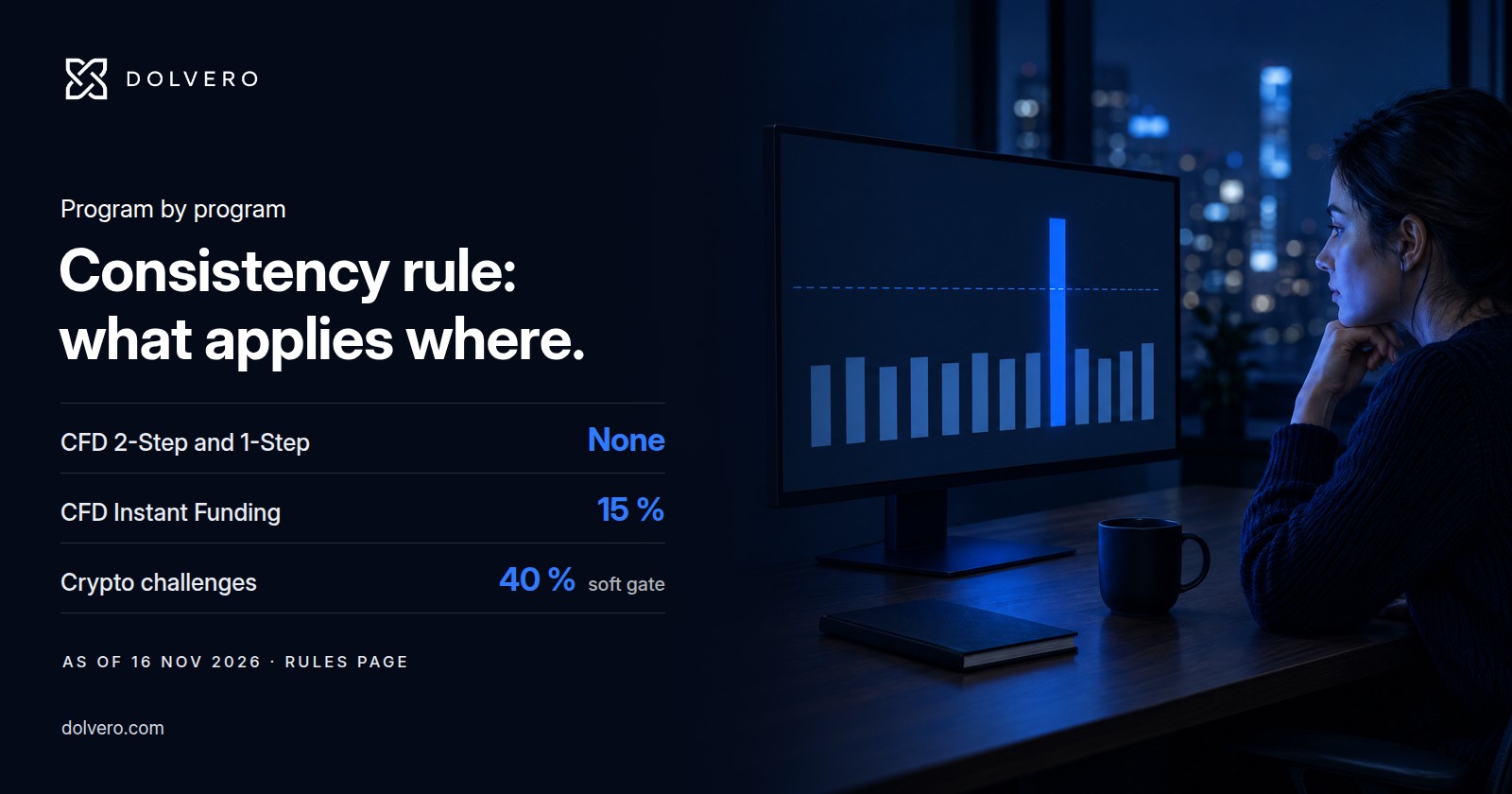
| Consistency rule | none 15% applies to Instant Funding only | A best-day rule can hold a payout for weeks after the profit is already made. The money is earned but not yet yours. |
| Time limit | none on every phase | A 30-day clock turns a bad month into a repurchase. No clock means an evaluation costs once. |
| Inactivity rule | none on 2-Step 7 days on Instant Funding | An account closed for not trading is a fee paid for nothing. |
| Cap per trade idea | 2% No Risk Limit removes it for +25% | The cap means no single idea can take more than 40% of the daily allowance, which is why it protects the fee you already paid. |
| Profit split | 80%, 90% with +20% | Ten points of split on a $100,000 account is worth more per month than the entire fee. |
| Minimum trading days | 5 per phase | A day counts only if closed profit is at least 0.5% of the starting balance, so five days with a trade is not five qualifying days. |
| Fee refund | 100% with the 2nd payout | The trigger, not the promise, is what matters. Ours is a payout you request, not a target we set later. |
These levers differ from firm to firm, and none of them is on a pricing page. The rule-by-rule comparison, with a source link for every value, is in Prop Firm Rules Compared 2026.
The cheapest first rung, if $549 is not the starting point
Not every trader is buying $100,000 today. Dolvero's ladder starts at $19 for a $3,000 2-Step and $29 for a $3,000 Instant account. The $5,000 Instant Funding account is $15, with a 3% daily loss limit, a 5% trailing floor, a 70% starting split and the 15% consistency rule. At $15 for $5,000 that is $3.00 per $1,000 of buying power, and it puts you on a funded account rather than an evaluation from the first trade. The rules on it are tighter than the 2-Step, which is the trade being made: less money at risk, less room to move.
Where Dolvero stands out
- Cheapest $100K route
- $5492-Step list price, $494.10 with Relaxed Risk
- Net cost when funded
- $0fee refunded with the 2nd payout
- Consistency rule
- Noneon 2-Step and 1-Step
- Time limit
- Noneon any phase
- Scaling
- up to +25%every 3 months, based on consistent profit, up to $200,000
- Payout ledger
- Publicevery payout listed with amount, method and processing time
Frequently asked questions
What is the cheapest way to get a $100,000 funded account in 2026?
At Dolvero, the cheapest ticket is the 2-Step evaluation at a list price of $549, or $494.10 with the Relaxed Risk add-on, which also widens the limits to 4% daily and 8% maximum. The cheapest route per dollar of capital is to buy the $50,000 2-Step at $299 and aim for scaling, which may add up to 25% every three months on consistent profit and would take the account past $122,000 after a year if every step were granted at the full 25%.
How much does a $100,000 two-phase challenge cost at other firms?
Prices and promotions change, and some firms list in euros, so check each firm's own pricing page on the day you buy. At Dolvero the $100,000 2-Step is $549, refunded in full with your second payout.
Do I get the Dolvero fee back?
Yes, in full, with your second payout, on every challenge type including Instant Funding. The first payout can be requested 14 days after your first trade on the funded account and the next one 14 days after that, so the refund typically lands about four weeks into the funded account.
How much do add-ons add to the price?
They are percentages of the evaluation fee. On the $549 2-Step, News Trading and Weekend Holding are +15%, or $82.35 each; Profit Split Boost is +20%, or $109.80, and No Risk Limit is +25%, or $137.25; Relaxed Risk is a 10% discount worth $54.90. All four additive add-ons together take the $100,000 2-Step to $960.75.
Is Instant Funding cheaper than passing an evaluation?
No. The $100,000 Instant account is $749 against $549 for the 2-Step, because you skip the evaluation. The gate moves to the payout instead: ten profitable days of at least 0.5% before each payout request and no single day above 15% of the net profit of the payout cycle, and the split starts at 70%, moves to 80% on the second payout and 90% from the third.
Is it cheaper to fail twice at Dolvero or to pass once somewhere more expensive?
Two attempts on the $100,000 2-Step cost $1,098 in cash, and the refund on the successful one brings the net cost to $549. That is the arithmetic to compare against any single-attempt price elsewhere. The bigger lever is not the ticket: position size inside the 2% per-trade and 5% daily limits decides how many tickets you buy.
Every price, every add-on, no surprises at checkout
The pricing page shows the list price for each account size and each model, with the add-on percentages applied live before you pay. The rules that decide whether that price stays low are public and versioned.
- Dolvero: pricing and add-ons, trading rules and FAQ (model parameters, add-on percentages, news window, scaling, refund with the 2nd payout, payout cycle), account parameters from the Dolvero account catalogue, 21 November 2026